
Restoration-first commercial roofing across Western Pennsylvania · Call 814-720-1081
Home / Spray Foam Cost
Spray foam (SPF) roofing costs more per square foot than a coating, and it is buying something a coating does not: insulation. Comparing them on price alone understates it, so this page sets out how to run the payback properly.
Certified To Install


It gets patched, it holds through one dry spell, and it is back the next time the wind drives rain the wrong way.
We find where the water actually gets in before anyone quotes you a system.
A full tear-off was quoted on a roof that may not need one, and nobody showed you the condition of the deck.
We say so when a roof does not need replacing, even though replacing it pays us more.
Mil thickness, ponding ratios, a system name you were told to trust. You are responsible for the building and cannot check a word of it.
Nothing happens on your roof without you knowing first. That is the rule here, not a slogan.
That is the one that costs the most and it is the reason this company exists. The contractor who came in sixty thousand dollars cheaper than us on a roof nearby is no longer trading. We are the ones installing the replacement.
Ask us who services your roof in year three. It is the only question on this page we can answer with a name.
Comparing spray foam roofing and coating on cost per square foot compares a roof that insulates with a roof that does not. It is the one place on this site where the cheaper option can genuinely be the more expensive decision.
We do not publish a per-foot price on this site, and it is worth saying why rather than leaving you to wonder. A number that ignores how much of your insulation is wet, how many penetrations the roof carries and how material gets up there is not a price, it is a lead magnet you would then budget against. What this page gives you instead is the arithmetic to turn the quotes you are already holding into numbers you can actually compare.
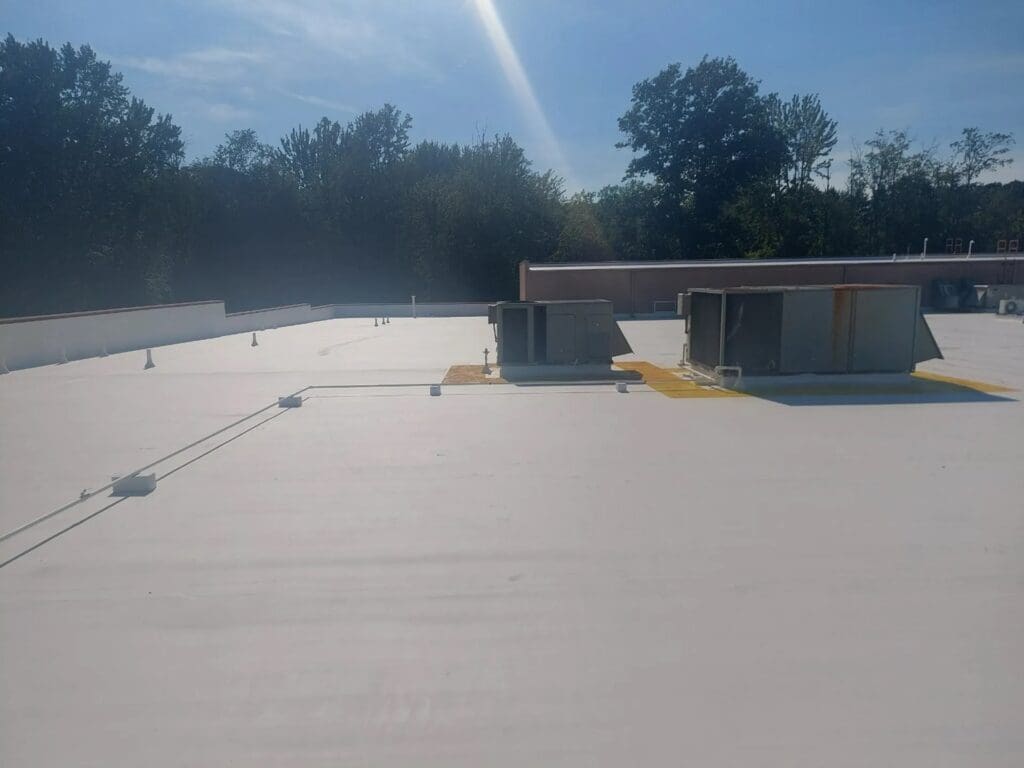
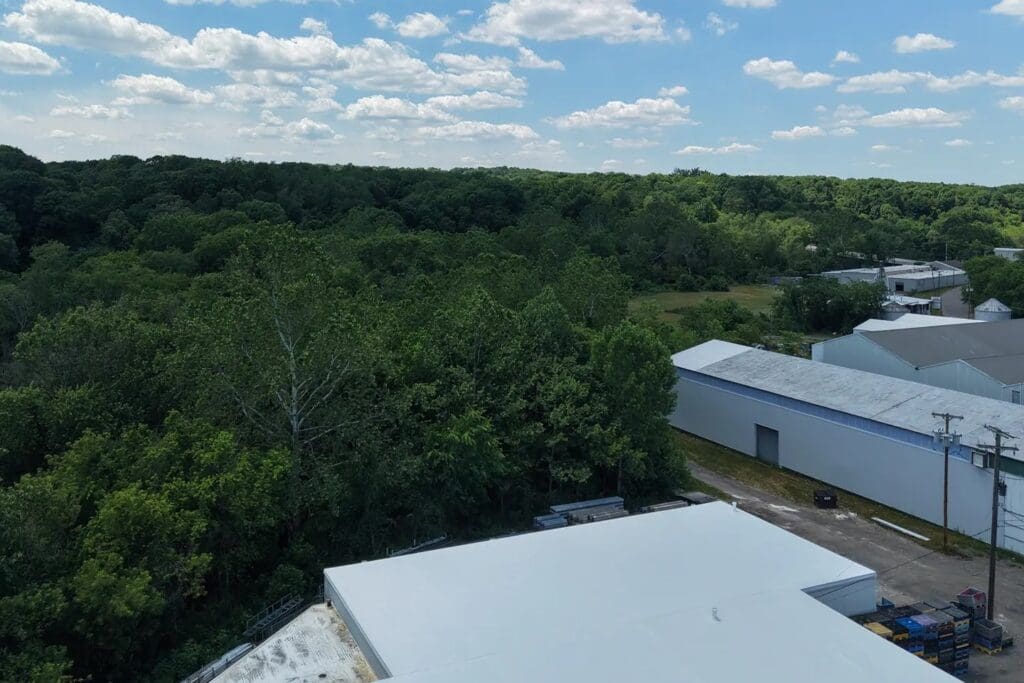
Twelve months of utility bills and the difference between the two quotes is enough to get a defensible answer, and it takes an afternoon rather than a study.
If the payback does not stack up, the coating is the better buy and we will say so. What the foam system actually does is covered separately.
Foam is applied to a specified depth and adds roughly R-6.3 per inch as it goes down. More depth is more material and more insulation, so the price and the energy benefit move together. That is the whole trade-off.
Foam can be built up to re-establish fall toward drains, which is the honest fix where the slope has been lost. That is extra material in the low areas and it is why a ponding roof costs more to correct than a flat one to protect. Ponding is a drainage problem.
Foam bonds to what is underneath, so the substrate has to be sound, dry and clean. Wet insulation comes out first, always, and on a saturated roof that is a significant share of the job.
Foam is always coated for UV and mechanical protection, so a foam roof is two systems. That is included in a proper quote and it is a common omission in a cheap one.
Ask each bidder for the area they priced. Building footprint is the floor, not the roof, and quotes written off the wrong number are not comparable to anything.
Quote divided by square feet is the per-foot number for your building. It is the only per-foot figure that means anything, because it is yours.
Now the quotes are on one scale. Gaps that looked like personality turn out to be scope.
Specified thickness, what happens to wet insulation, and whether the manufacturer warranty is registered. Nearly every gap lives in those three.
Straight answers on cost, timeline, and what a restoration actually involves. No jargon, no sales pressure.
A free, photo-documented assessment and honest numbers on restore versus replace.
Take the difference between the foam quote and the coating quote, then compare it against what the roof is costing you in energy now. Your utility bills and the building’s conditioned volume are the inputs, and your facilities team or your utility can usually help with the second. The honest answer is that it pays back well on a tall conditioned building and poorly on a high-air-change warehouse.
Per square foot, usually yes. Against the right comparison, often no. If your assembly is thin or saturated, a coating solves the water and leaves the energy problem exactly where it was, and you may end up paying twice. The comparison page sets out which situation you are in.
That depends entirely on how much your building loses through the roof, which is a real question rather than a rhetorical one. It is significant on a heated and cooled space with a tall interior volume, and much less so on a building that exchanges air constantly. Ask us to be honest about which one yours is.
No more than a coating does. The foam stays and the protective coating over it is renewed at the end of its term, which is the same renewable cycle. Recoating rather than replacing is the long-run argument for both.
Yes, and on any roof where foam is genuinely a candidate we will. Both numbers with the assumptions written next to each, so the trade-off is yours to make rather than ours to recommend.
Request your free, photo-documented roof assessment. Honest options, firm numbers, and a roofer who will still be here next year.
Free assessment · Photo-documented · No obligation, no pressure