
Home / Ponding Water
Ponding Water on a Flat Roof, and Why It Will Not Fix Itself
Water still sitting on the roof forty eight hours after the rain stopped is ponding. It is a drainage problem showing up as a roofing problem, and it quietly causes a large share of everything else that goes wrong up there.
- Free, photo-documented roof assessment
- Restore and replace numbers, every time
- Warranties honored the full term, up to 20 years
Certified To Install


You have probably
been here before.
The leak keeps coming back.
It gets patched, it holds through one dry spell, and it is back the next time the wind drives rain the wrong way.
We find where the water actually gets in before anyone quotes you a system.
The replacement quote made you wince.
A full tear-off was quoted on a roof that may not need one, and nobody showed you the condition of the deck.
We say so when a roof does not need replacing, even though replacing it pays us more.
You were talked over, not talked to.
Mil thickness, ponding ratios, a system name you were told to trust. You are responsible for the building and cannot check a word of it.
Nothing happens on your roof without you knowing first. That is the rule here, not a slogan.
That is the one that costs the most and it is the reason this company exists. The contractor who came in sixty thousand dollars cheaper than us on a roof nearby is no longer trading. We are the ones installing the replacement.
Ask us who services your roof in year three. It is the only question on this page we can answer with a name.
Why Ponding Is Usually Not About the Roof
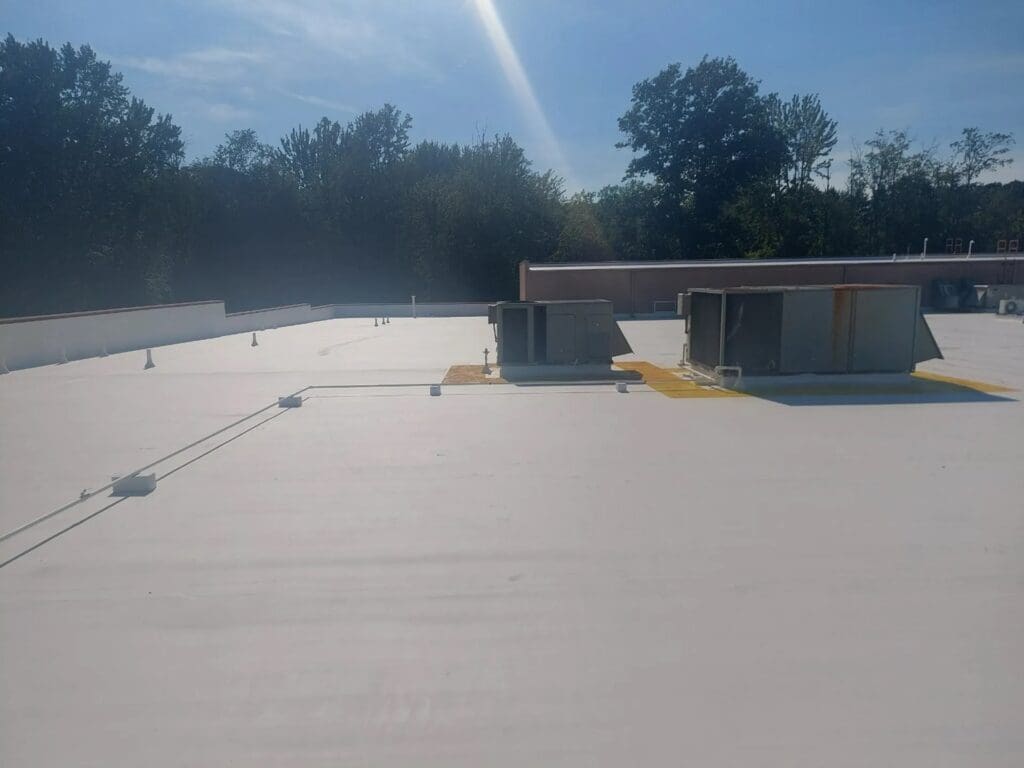
Flat roofs are not flat. They are built with a slight fall toward drains, and ponding means that fall has been lost or blocked somewhere. Insulation crushed by foot traffic, a deck deflecting under load, a drain sitting proud of the surface, or a rooftop unit installed straight across the path of the water.
So the first question is never which coating. It is why is the water not leaving.
How a Small Low Spot Becomes a Large One
Water collects in a slight depression. The weight makes the depression deeper. The deeper depression collects more water. Left alone, a puddle after heavy rain becomes a permanent pond that no longer dries between storms.
Which is why ponding is worth dealing with while it is still small and cheap, and why it belongs in a maintenance program rather than an emergency call.
What Standing Water Is Actually Doing
It is constant exposure.
Every seam, fastener and lap under that pond is wet all the time instead of shedding and drying. A detail that would last twenty years dry does not last twenty years submerged.
It is weight.
Water is heavy, and an inch of it across a wide area is a serious load. On a deck that already deflects slightly, the load makes the low spot lower, which collects more water. That is a loop, not a state.
It grows algae and holds dirt.
Standing water leaves deposits and biological growth that hold moisture even between rains, and on reflective surfaces it destroys the reflectivity that was part of the point.
It hides what is underneath.
You cannot inspect what is under a pond, so damage under it goes unfound until the insulation is wet across a wide area.
Four Ways Ponding Actually Gets Solved
Find out why it is there
Blocked drains, crushed insulation, a deflecting deck, a badly placed unit or an addition that changed the slope. The cause decides the fix, and it is usually not the roof surface.
Clear and correct the drainage
Often the cheapest real fix. Drains and scuppers that are blocked, undersized or higher than the surrounding surface are behind a large share of ponding.
Build the low spot back up
Tapered insulation in the affected area re-establishes fall toward the drain, so the roof sheds instead of holding. This is the honest fix where the deck is sound and the slope has been lost.
Then protect it
Once it drains, a fabric-reinforced coating system goes over sound substrate. Coating over a pond without fixing the drainage is putting a new surface on the same problem.
Ponding Questions
Straight answers on cost, timeline, and what a restoration actually involves. No jargon, no sales pressure.
A free, photo-documented assessment and honest numbers on restore versus replace.
How long can water sit before it counts as ponding?
The working rule is forty eight hours after rain stops in drying weather. Anything still there is ponding, and it should be treated as a fault rather than a feature of a flat roof.
Can you just coat over a pond?
Not honestly. Some coatings tolerate immersion better than others, and silicone tolerates it best, but a coating does not create slope. If the drainage is not corrected the water is still there, still weighing on the same low spot and still finding the same details. We fix the fall first, then coat.
Is silicone the answer to ponding?
It is the better material where water sits, which is why we specify it in those conditions. It is not a substitute for drainage. Silicone versus acrylic covers where each one wins and loses.
Is ponding water dangerous to the building?
It can be. The load is real, and it concentrates exactly where the deck is already deflecting. On an older building, or one where the deck has been wet for a long time, it is worth taking seriously rather than watching.
My roof has always ponded and never leaked. Do I need to do anything?
It means the details under it have held so far, which is worth knowing. It also means they have been under constant exposure the whole time and the insulation may be wet without a leak showing. It is the kind of thing an assessment answers cheaply.
Start With the Truth About Your Roof
Request your free, photo-documented roof assessment. Honest options, firm numbers, and a roofer who will still be here next year.
Free assessment · Photo-documented · No obligation, no pressure