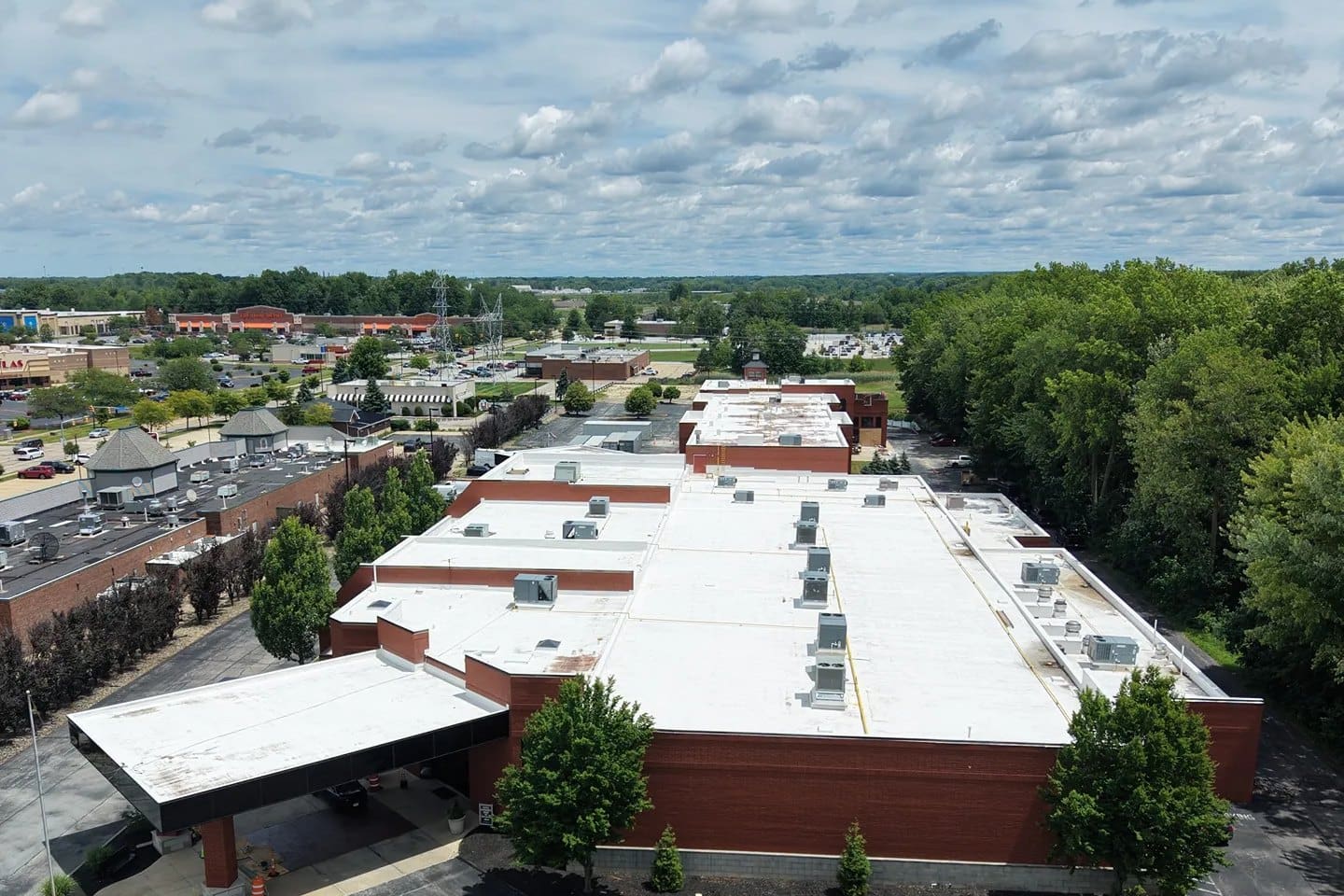
Small, crowded and customer-facing. A retail roofing contractor sees more equipment per square foot on these roofs than almost anywhere else, and the work has to happen without a shopper ever noticing it.
Roof area
Often 5,000 to 40,000 sq ft
Usually
Single-ply carrying heavy equipment for its size
Fails first
Curbs and penetrations
A leak costs
A closed unit, and a lease argument
The situation
What actually goes wrong on a retail roof
A single retail unit can carry rooftop units for heating, cooling and kitchen exhaust, plus refrigeration lines, conduit and vents. Each one is a hole in the roof with a curb around it.
That is why retail roofs leak long before they are old, and why retail store roof restoration is mostly detail work rather than surface work.
In multi-tenant retail the split of responsibility between landlord and tenant is where roof problems stall. The leak is real, the ownership is disputed, and nothing happens.
A photographed assessment showing exactly what failed and where is usually what unblocks it, whichever side of the lease you are on.
Why this building type
Busy Roofs Above Trading Hours
Equipment density is the problem, not size.
A retail roof is a fraction of a warehouse and has more units, curbs and conduit on it. Every one of those is a penetration, and penetrations are where the roof leaks.
Trading hours are non-negotiable.
Nobody accepts noise, smell or a closed entrance over their trading day. Sequencing, access and timing are agreed before scheduling rather than discovered on day one.
Who pays is often genuinely unclear.
On leased retail the roof usually sits with the landlord and the rooftop units with the tenant, and the leak is at the joint between the two. Getting that established early saves a lot of argument later.
Worst first
Four Steps Above a Trading Store
1
Survey the equipment first
Every unit, curb, duct and conduit run mapped and photographed. On retail this is the roof survey, more than the field is.
2
Agree access and hours
Where the lift goes, when crews arrive, how materials reach the roof without crossing a customer path. Settled before a date is set.
3
Detail every penetration
Each curb and unit sealed and fabric-reinforced individually. This is where the leaks are and it is where the time goes.
4
Coat, register, document
Full system across the field, registered for warranty, with the photographs a landlord or a tenant can use to settle who owns what.
Yes, and usually that is the arrangement. There is no tear-off, so no debris and no open deck. We plan access so nothing crosses a customer route, and noisy work is scheduled where it least intrudes.
It is one of the most common causes we see, and it is usually fixable as a detail rather than a roof job. It also matters for your warranty, because work by other trades on the roof is the main thing that voids coverage.
Depends on the lease, and it is worth checking before spending anything. Typically the structure and roof sit with the landlord and the rooftop units with the tenant. We will document what we find so either party can act on it.
Days rather than weeks on most units, weather allowing. The detailing takes longer than the field, which surprises people who assume a small roof is a quick job.
Not sure which of these applies to your building? Call 814-720-1081 and describe it.
The Next Step
Start With the Truth About Your Roof
Request your free, photo-documented roof assessment. Honest options, firm numbers, and a roofer who will still be here next year.