
Home / Seam Failure
Why Flat Roof Seams Fail, and What Actually Fixes Them
Commercial flat roofs almost never fail in the middle of the field. They fail where two pieces meet. Understanding why is most of understanding your roof.
- Free, photo-documented roof assessment
- Restore and replace numbers, every time
- Warranties honored the full term, up to 20 years
Certified To Install


You have probably
been here before.
The leak keeps coming back.
It gets patched, it holds through one dry spell, and it is back the next time the wind drives rain the wrong way.
We find where the water actually gets in before anyone quotes you a system.
The replacement quote made you wince.
A full tear-off was quoted on a roof that may not need one, and nobody showed you the condition of the deck.
We say so when a roof does not need replacing, even though replacing it pays us more.
You were talked over, not talked to.
Mil thickness, ponding ratios, a system name you were told to trust. You are responsible for the building and cannot check a word of it.
Nothing happens on your roof without you knowing first. That is the rule here, not a slogan.
That is the one that costs the most and it is the reason this company exists. The contractor who came in sixty thousand dollars cheaper than us on a roof nearby is no longer trading. We are the ones installing the replacement.
Ask us who services your roof in year three. It is the only question on this page we can answer with a name.
The Field Is Fine
When we open up a commercial roof that has been leaking for years, the membrane across the open field is usually in reasonable condition. The damage is concentrated at laps, at curbs, around penetrations and at the edges.
That is a hopeful finding rather than a discouraging one, because it means the expensive part of the roof is still doing its job.
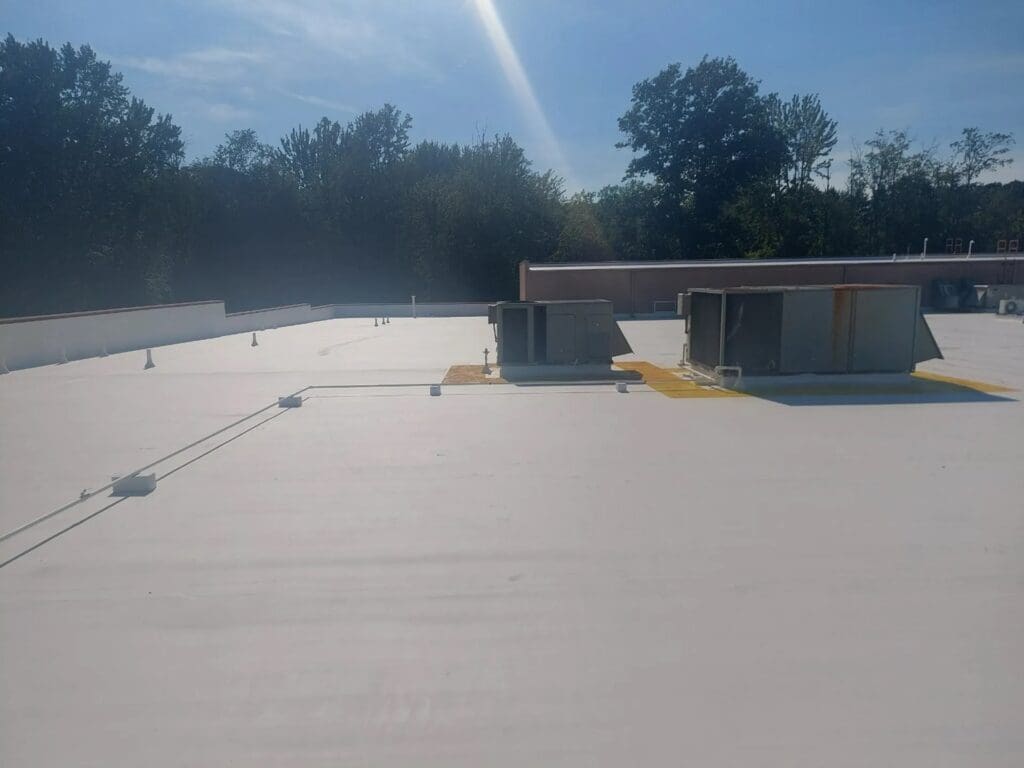
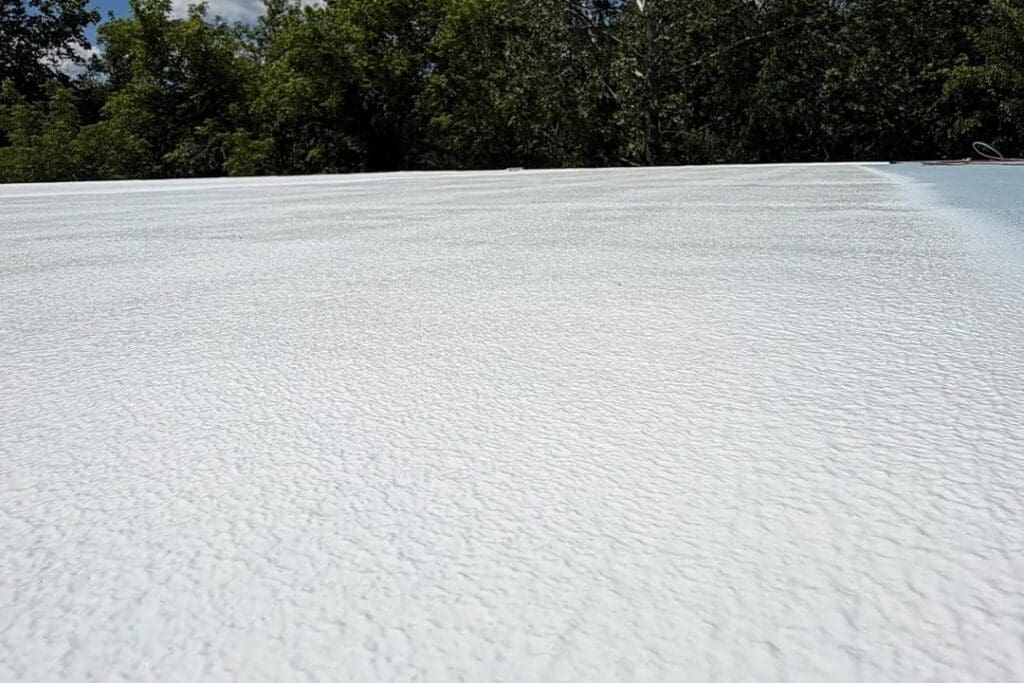
A Roof With No Field Seams Cannot Fail at Them
Once you accept that seams are the failure point, the logic of a seamless system follows. Reinforce the existing details so they move without opening, then cover the whole roof in a continuous membrane that has no laps of its own.
The roof still has curbs and penetrations, and those still need detailing and inspection. It just no longer has hundreds of feet of hand-made joint waiting to age out.
Four Reasons a Seam Opens
Daily thermal movement.
A roof expands and contracts every day of its life and the seam is where that movement concentrates. Over thousands of cycles the bond at the lap is worked, and it fails at the weakest point first.
Adhesive and sealant age.
Whatever holds the lap closed, adhesive, heat weld or sealant, has a service life shorter than the membrane’s. UV and heat shorten it further on a dark or ponding roof.
Workmanship at the original install.
Seams are hand-made, hundreds of feet of them, often in poor conditions. A cold weld or a contaminated lap can sit undetected for a decade and then be the first thing to open.
Standing water on the lap.
A seam under a pond is wet continuously rather than shedding and drying. Ponding turns an aging seam into a leaking one years earlier than it would have.
Four Steps That Outlast the Movement
Find every seam, not the leaking one
On a roof of a certain age the seams are all the same age. Repairing one and leaving the rest is how a roof gets four service calls in two years.
Clean and prepare the lap
Adhesion at a seam repair is decided here, on a surface that has had years of dirt and weathering worked into it.
Embed fabric across the joint
Polyester fabric set into the base coat spans the seam and moves with it, instead of resisting the movement the way the original lap did.
Coat the field seamlessly
So that once the details are reinforced there are no field seams left to open. That is the point of a fluid-applied system.
Seam Failure Questions
Straight answers on cost, timeline, and what a restoration actually involves. No jargon, no sales pressure.
A free, photo-documented assessment and honest numbers on restore versus replace.
Can seams just be re-welded or re-sealed?
Sometimes, on a newer roof where the membrane is still in good condition and the failure is isolated. On an aging roof it treats one symptom of a condition affecting every lap, which is why the same building tends to call back.
How do I know a seam is failing before it leaks?
Visible lifting or fishmouthing at the lap edge, a lap that has gone hard and shiny, or a seam that has picked up a line of dirt where water sits against it. An inspection catches these while they are cosmetic, which is the argument for having one.
Why does fabric reinforcement work when sealant did not?
Because it changes what the detail is being asked to do. Sealant resists movement and eventually loses. Embedded fabric accommodates movement, spanning the joint with something that stretches and returns. It is the difference between a repair that ages well and one that fails on the first hard temperature swing.
Is this the same problem on metal roofs?
Same principle, different detail. On metal it is lap seams plus thousands of fasteners. The metal version is here.
Does a failing seam mean the roof is finished?
Usually not. Seam failure is a detail problem on what is often a structurally sound roof, and it is precisely the situation restoration is built for. What decides it is the deck and how much insulation is already wet.
Start With the Truth About Your Roof
Request your free, photo-documented roof assessment. Honest options, firm numbers, and a roofer who will still be here next year.
Free assessment · Photo-documented · No obligation, no pressure