Home / Screw-Down Metal Seams
Screw-Down Metal Roof Leaking at the Seams
This is the single most common metal roof failure we are called to, and it is almost never the panels. It is thousands of fasteners and hundreds of feet of lap seam doing what thermal movement makes them do.
- Free, photo-documented roof assessment
- Restore and replace numbers, every time
- Warranties honored the full term, up to 20 years
Certified To Install


You have probably
been here before.
The leak keeps coming back.
It gets patched, it holds through one dry spell, and it is back the next time the wind drives rain the wrong way.
We find where the water actually gets in before anyone quotes you a system.
The replacement quote made you wince.
A full tear-off was quoted on a roof that may not need one, and nobody showed you the condition of the deck.
We say so when a roof does not need replacing, even though replacing it pays us more.
You were talked over, not talked to.
Mil thickness, ponding ratios, a system name you were told to trust. You are responsible for the building and cannot check a word of it.
Nothing happens on your roof without you knowing first. That is the rule here, not a slogan.
That is the one that costs the most and it is the reason this company exists. The contractor who came in sixty thousand dollars cheaper than us on a roof nearby is no longer trading. We are the ones installing the replacement.
Ask us who services your roof in year three. It is the only question on this page we can answer with a name.
The Metal Is Usually the Part That Is Fine
Owners of leaking metal buildings frequently assume the roof is finished, because the leaks are everywhere at once. That pattern is not a dying roof, it is thousands of identical details reaching the end of their life at the same time, which is exactly what you would expect.
The panels themselves are often structurally sound and will carry a restoration comfortably.
A Coating Alone Does Not Span a Moving Joint
A film of coating stretched over a live seam splits where the seam splits, because it is being asked to resist movement rather than accommodate it. That is the fair criticism of thin coatings on metal roofs and we agree with it.
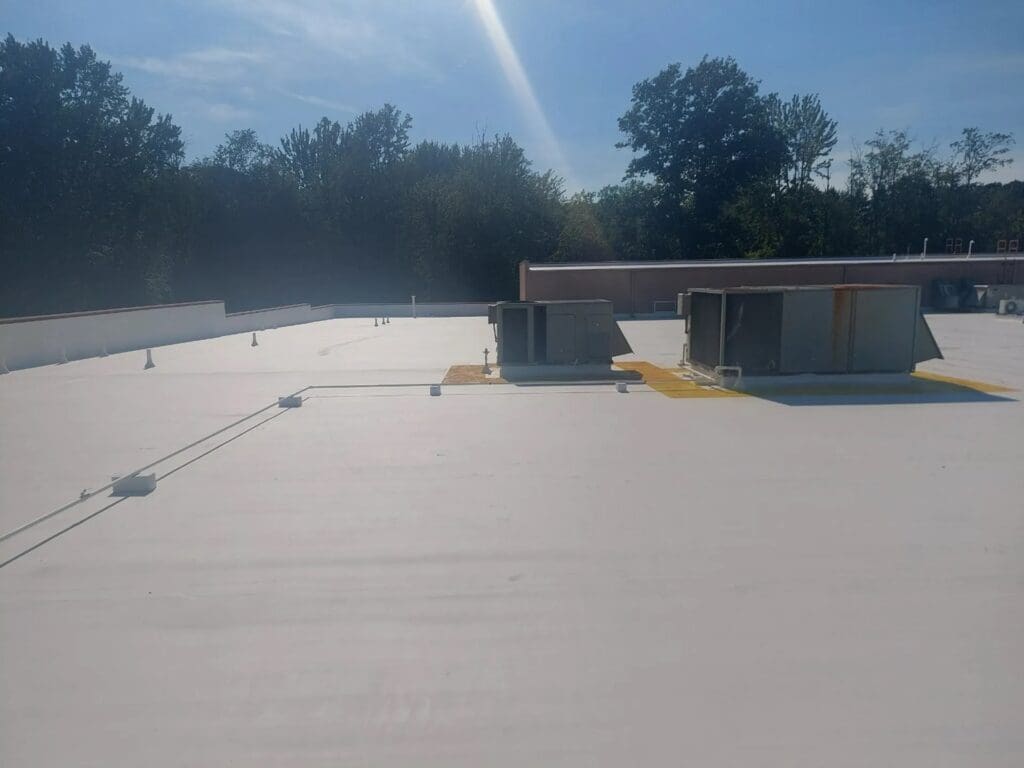
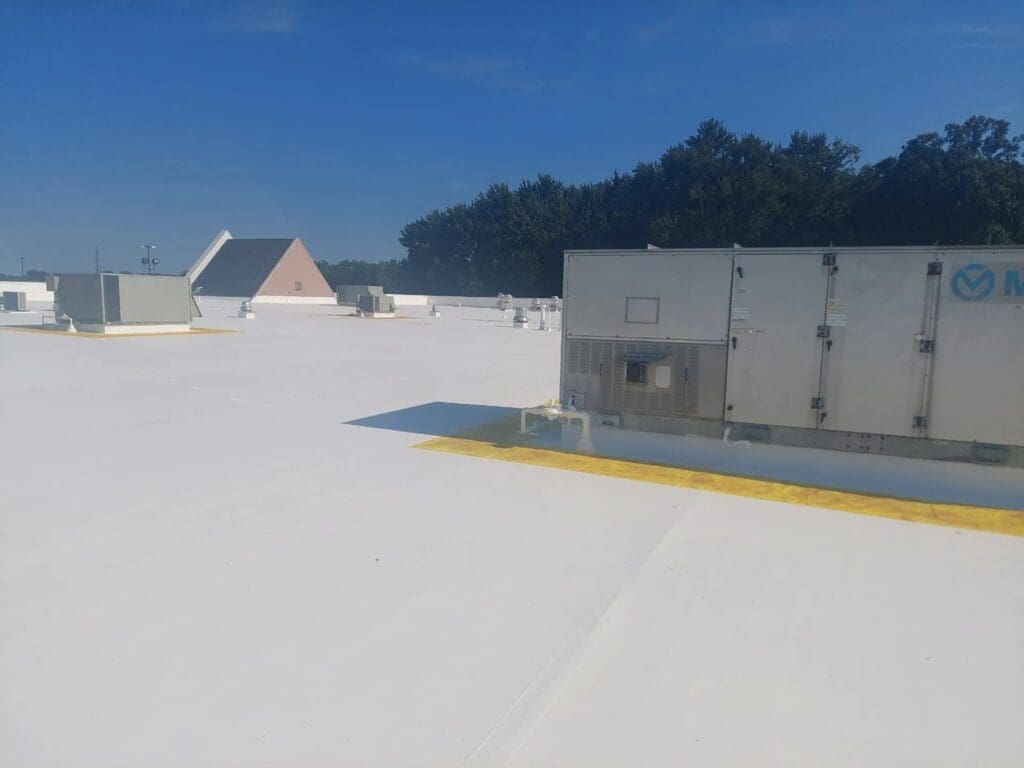
Fabric embedded into the coating at every seam and fastener spans the joint and moves with it. It is most of the labor on a metal restoration and it is the entire reason the result lasts. The fabric page goes further.
Four Things Moving on Your Roof Every Day
The panels expand and contract, the fasteners do not.
A long metal panel moves measurably between a January night and a July afternoon. The screw holding it does not move with it, so the hole slowly becomes larger than the screw.
Washers harden and split.
The neoprene washer under each screw head is the actual seal, and it is the shortest-lived component on the roof. Once it hardens, every fastener is a small open hole.
Lap seams work open.
Panel laps rely on sealant and clamping force. Movement plus years of UV turns that sealant brittle, and wind-driven rain finds the gap long before standing water does.
Fasteners back out.
Repeated movement walks screws upward. You can often see it from the ground as a line of raised heads, and each one is a direct path into the building.
Four Steps That Address the Movement Rather Than the Symptom
Reset or replace every fastener
Backed-out screws are reset, failed ones are replaced with larger-diameter fasteners that bite into sound metal rather than a worn hole.
Reinforce every seam
Fabric is embedded into the base coat along the full length of each lap, so the detail spans the movement instead of resisting it.
Detail every penetration and termination
Curbs, pipes, vents and edges get the same treatment, because they move too and they are where the second round of leaks appears otherwise.
Coat the field
A seamless membrane over the whole roof, registered for a manufacturer warranty. The metal coating page covers the system.
Screw-Down Seam Questions
Straight answers on cost, timeline, and what a restoration actually involves. No jargon, no sales pressure.
A free, photo-documented assessment and honest numbers on restore versus replace.
Can I just replace the screws and re-seal the seams?
You can, and it will work for a while. The reason it comes back is that the new sealant is being asked to do the same job the old sealant failed at, on a roof that has not stopped moving. Reinforcement with embedded fabric is what makes the repair outlast the movement.
How do I know it is the seams and not the panels?
Look at where the water shows up inside relative to the panel laps, and look at the fastener line from the ground for raised heads. Then have it walked. Panel failure is visible as section loss or rust through, which is a different diagnosis. Rust has its own page.
It only leaks in driving rain. Is that normal?
It is the classic signature of an open lap or a failed side detail rather than a hole in the field. Water is being pushed sideways into a gap it would run past in vertical rain. Tell us that detail, it narrows the search considerably.
Is the whole roof going to need this?
Usually yes on a roof of this age, and that is not upselling. The fasteners and seams are all the same age and have all had the same weather. Doing a third of them buys you a year and a second mobilization.
How long does the fix last?
The systems we install are warranted up to twenty years depending on specification, and a maintained metal roof is normally recoated at the end of that rather than replaced.
Start With the Truth About Your Roof
Request your free, photo-documented roof assessment. Honest options, firm numbers, and a roofer who will still be here next year.
Free assessment · Photo-documented · No obligation, no pressure