Home / Recoating
Recoating, and Why You Should Never Buy the Same Roof Twice
A replaced roof starts a countdown to the next replacement. A restored roof can be renewed at the end of its term for a fraction of the original, which changes the arithmetic over the time you actually own the building.
- Free, photo-documented roof assessment
- Restore and replace numbers, every time
- Warranties honored the full term, up to 20 years
Certified To Install


You have probably
been here before.
The leak keeps coming back.
It gets patched, it holds through one dry spell, and it is back the next time the wind drives rain the wrong way.
We find where the water actually gets in before anyone quotes you a system.
The replacement quote made you wince.
A full tear-off was quoted on a roof that may not need one, and nobody showed you the condition of the deck.
We say so when a roof does not need replacing, even though replacing it pays us more.
You were talked over, not talked to.
Mil thickness, ponding ratios, a system name you were told to trust. You are responsible for the building and cannot check a word of it.
Nothing happens on your roof without you knowing first. That is the rule here, not a slogan.
That is the one that costs the most and it is the reason this company exists. The contractor who came in sixty thousand dollars cheaper than us on a roof nearby is no longer trading. We are the ones installing the replacement.
Ask us who services your roof in year three. It is the only question on this page we can answer with a name.
The Default Most Owners Are On
Replace a roof and you have bought an asset with an expiry date. In twenty years somebody pays to remove it and buy another one, and the building goes through the whole disruption again.
That cycle is so normal in commercial property that it is rarely questioned. It is also avoidable on any roof whose deck stays sound.
Where the Arithmetic Actually Lands
Over a long hold the comparison is not one restoration against one replacement. It is a restoration plus a renewal against a replacement plus, eventually, another replacement.
That is the compounding argument, and it is the reason we would rather you understood the renewal cycle before the first job than discover it at year fifteen. What drives the first number is set out separately.
What Renewable Means in Practice
A recoat is a fraction of the original restoration.
At the end of a warranted term, a roof that has been maintained does not need the preparation and detail work again. It needs a new surface layer, which is the cheaper part of the original job.
The warranty term resets.
A recoat is registered as its own warranted system rather than an extension of goodwill. You are buying coverage again, not hoping the old coverage stretches.
The building never has an exposed-deck event again.
Each renewal is another no-tear-off operation. Over thirty years of ownership that is the difference between one disruptive project and none.
It rewards maintenance instead of punishing it.
A roof kept under inspection arrives at year fifteen as a recoat candidate. A roof left alone arrives there as a replacement. The program exists for exactly that reason.
Four Steps at the End of a Term
Assess the existing system
Same discipline as the first time: walk it, scan it, photograph it. Renewal is a finding, not an assumption.
Repair what has moved
Details that have worked, new penetrations added since, anything mechanical damage has caught. Usually a short list on a maintained roof.
Recoat the field
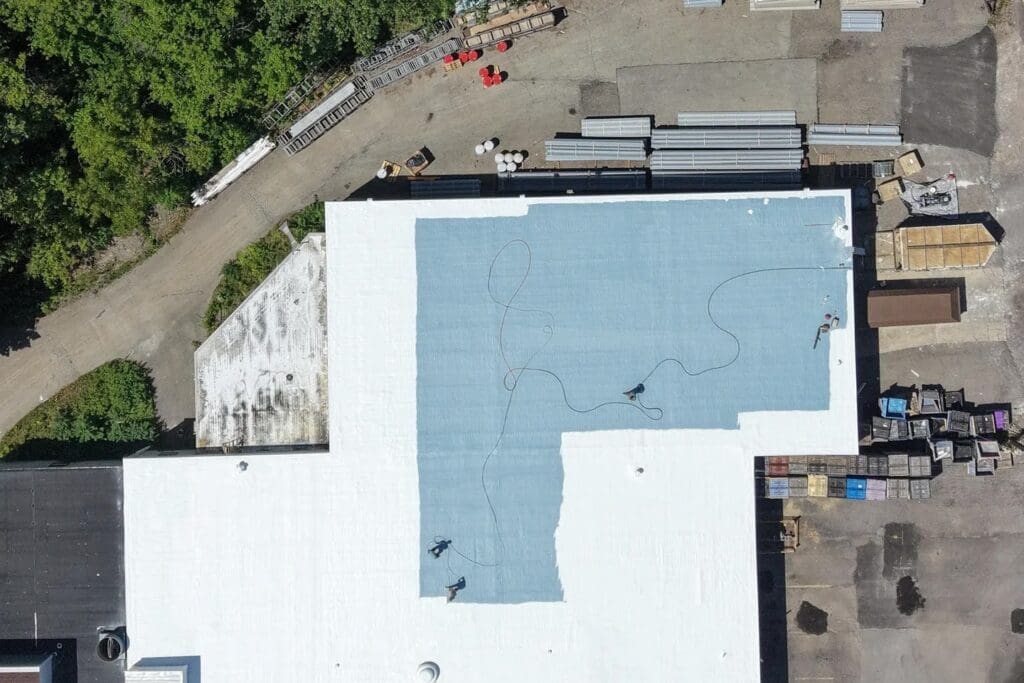
A new surface layer to the specified thickness over a system that is already sound underneath.
Register the new term
Documentation for your records, which is also what keeps the next renewal straightforward.
Recoating Questions
Straight answers on cost, timeline, and what a restoration actually involves. No jargon, no sales pressure.
A free, photo-documented assessment and honest numbers on restore versus replace.
How many times can a roof be recoated?
There is no fixed limit while the assembly underneath stays sound and dry, which is the real condition. Roofs are renewed on this cycle for decades. What ends it is water in the assembly or a failing deck, not the number of coats.
Does a recoat cost the same as the first restoration?
No, and that is the point. The first job carries the preparation, the wet-insulation replacement and all the detail reinforcement. A recoat on a sound, maintained system is materially less because that work is already done and still intact.
What happens if I skip maintenance and just recoat later?
Then the renewal turns back into a restoration, because the details will have moved and there may be water in the assembly again. It is still usually cheaper than replacement, it is just no longer the cheap version.
Is this only true for coatings?
It is true for fluid-applied systems generally, including a coated foam roof. A mechanically fastened single-ply roof does not renew this way, which is the structural difference between the two approaches.
How do I know when the term is nearly up?
We tell you, because the roof stays on our records with its registration and its inspection history. It should never be a surprise, and it should never be discovered by a leak.
Start With the Truth About Your Roof
Request your free, photo-documented roof assessment. Honest options, firm numbers, and a roofer who will still be here next year.
Free assessment · Photo-documented · No obligation, no pressure