
Restoration-first commercial roofing across Western Pennsylvania · Call 814-720-1081
Home / Roof Problems
A stain on the ceiling tells you there is water in the building. It tells you almost nothing about where it got in. This is the short guide to the commercial roof issues we see most often across Western PA, and which of them are urgent.
Certified To Install


It gets patched, it holds through one dry spell, and it is back the next time the wind drives rain the wrong way.
We find where the water actually gets in before anyone quotes you a system.
A full tear-off was quoted on a roof that may not need one, and nobody showed you the condition of the deck.
We say so when a roof does not need replacing, even though replacing it pays us more.
Mil thickness, ponding ratios, a system name you were told to trust. You are responsible for the building and cannot check a word of it.
Nothing happens on your roof without you knowing first. That is the rule here, not a slogan.
That is the one that costs the most and it is the reason this company exists. The contractor who came in sixty thousand dollars cheaper than us on a roof nearby is no longer trading. We are the ones installing the replacement.
Ask us who services your roof in year three. It is the only question on this page we can answer with a name.
The most useful thing to know about a commercial roof leak is that the water almost never comes in directly above where you see it. It gets in at a seam, a fastener or a penetration, then runs until it finds a way down through the ceiling.
Which is why chasing the stain is how a roof gets patched four times and still leaks. Finding the entry point is the actual job, and it is what the assessment is for.
Only in driving rain usually points at a vertical detail: a wall flashing, a curb, an open seam. After every heavy rain suggests water sitting somewhere it should not. During a thaw rather than during the snow points at drainage and ice.
Tell us when it happens, not just that it happens. It shortens the search considerably. Why a roof keeps leaking after repairs goes into the rest.
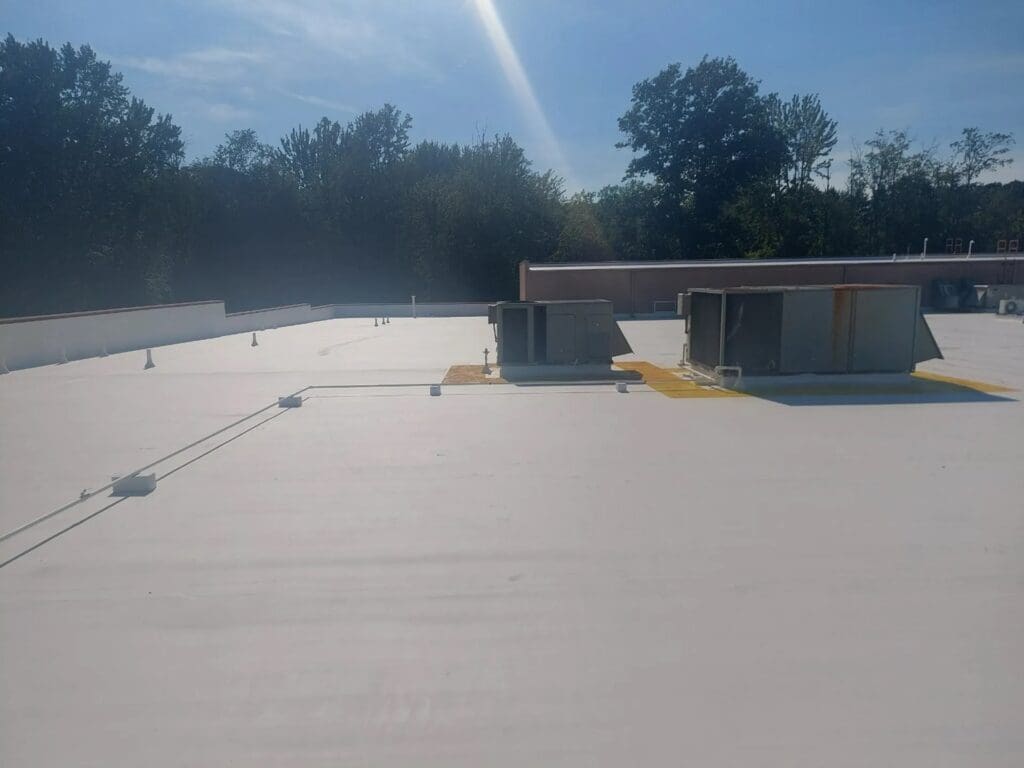
Flat roofs rarely fail in the middle. They fail where two pieces meet or where something comes through: seams, curbs, pipes, drains and units. That is where nearly every leak we chase begins.
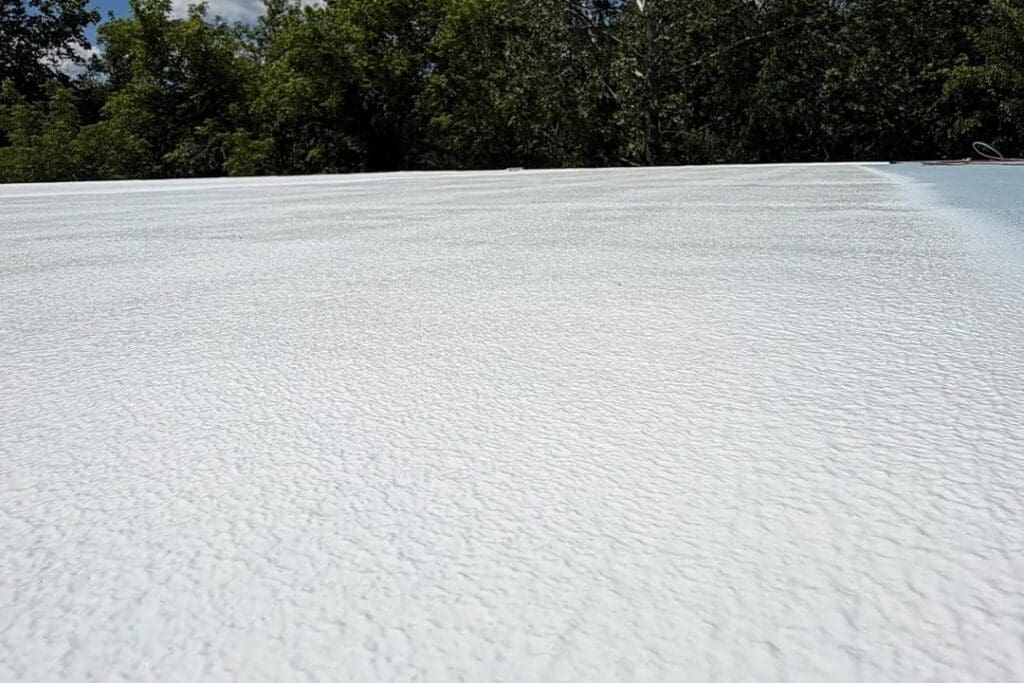
Water that is still on the roof two days after rain is finding every weakness continuously instead of running off. It is also weight. Ponding gets its own page because it causes so much of the rest.
Once water is in the insulation it spreads sideways, stops the roof insulating, and adds serious weight. It is invisible from the surface and it is the main thing a moisture scan is looking for.
On metal roofs, thermal movement backs fasteners out and works seams open a little at a time. The roof looks fine and leaks anyway, usually in wind-driven rain first.
An HVAC contractor, a solar installer or a cable run left undetailed is one of the most common causes of a new leak on a roof that was sound last month.
Membranes get brittle, coatings chalk, sealant at the details gives up first. Age alone rarely floods a building, but it makes everything above happen sooner.
Move stock, cover equipment, get buckets under it. The damage inside a building compounds faster than the damage on the roof does.
The stain, the ceiling, the room. Time-stamped photographs are worth a great deal later, for us and for any insurance conversation.
Nobody should be on a wet commercial roof. Whatever is happening up there will still be happening when it is safe.
Not patched blind. The assessment is free, photo-documented, and it finds the cause rather than the nearest symptom.
Straight answers on cost, timeline, and what a restoration actually involves. No jargon, no sales pressure.
A free, photo-documented assessment and honest numbers on restore versus replace.
Almost never. Water enters at a weak point, then travels along the deck, along a seam or down a purlin before it finds a hole in the ceiling. The stain marks where it fell out, not where it got in. That is the single biggest reason blind patching fails.
You usually cannot tell from the surface, which is the problem. An infrared or capacitance scan finds it, and it is part of an assessment on any roof where it matters. Signs that make it likely are soft spots underfoot, a roof that stopped insulating, and repeated leaks in the same area.
It is a clue rather than a comfort. A leak that only shows in wind-driven rain usually means an open seam or a flashing detail. One that shows after every heavy rain often means ponding. One that appears in a thaw can be ice at a drain. Intermittent does not mean minor.
Very often, yes. If the deck is sound and the wet area is limited, the wet insulation gets cut out and replaced, the details get reinforced, and the roof gets a warrantied coating system over the top. Restoration versus replacement covers where that line sits.
More urgent than it looks. It is continuous exposure at the weakest points plus real weight, and it accelerates everything else on this list. It is also usually a drainage problem rather than a roof problem, which means it will not fix itself.
Request your free, photo-documented roof assessment. Honest options, firm numbers, and a roofer who will still be here next year.
Free assessment · Photo-documented · No obligation, no pressure